


EXECUTIVE SUMMARY
TABLE OF CONTENTS
1. The GROW Model
2. The OSKAR Model
3. The DREAM Model
4. References and Links
5. After the Live Session: Lesson Miro Board
6. After the Live Session: Session Recordings
7. Mark this Lesson as COMPLETE
Summary: This lesson is the connecting point between the module ‘Become a Coach’ and ‘Become a Leader Coach’. We introduce 3 powerful Coaching Models:
- Two models to help Coach others for PERFORMANCE: GROW and OSKAR
- One model to help Coach others for GROWTH: DREAM
All models are simple, yet comprehensive for different purposes. In this lesson, we will introduce them, play with them and set them up as a foundation for our further journey to become Leader Coaches.
1. The GROW Model
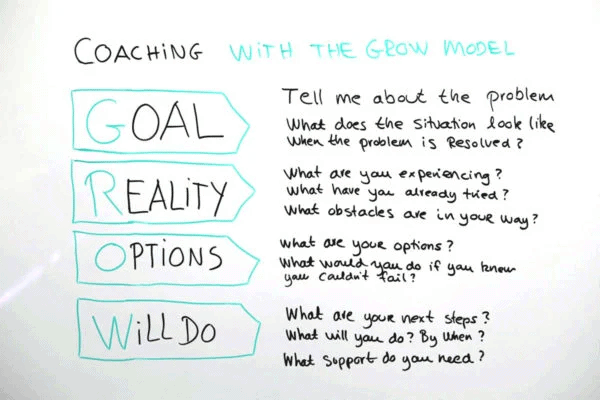
The GROW model is a simple and powerful tool to give structure to especially transactional coaching conversations.
GROW is an acronym and consists of the following four process steps, which are roughly expected to follow in sequence.
Goal
In this step, the coach either shares a goal or the client brings a goal forward. As opposed to transformational coaching, it can be useful to define a goal in this model using the SMART concept. This step is similar to entering the ‘destination’ in a maps app.
For example: A client wants to find a better way to handle conflicts in their team.
Reality
In this step, coach and client put the spotlight on the current reality. This refers to the current situation, available information and anything else that can be useful in moving forward to the goal. This step is similar to the starting point, before moving to our destination.
For example: The client mentions that there is currently no shared understanding in the team how conflicts are handled, now that everyone is working remotely. Conflicts simply erupt and distract in a major way, impacting the entire team’s performance.
Options
In this step, the coach helps the client think through options how to get from current reality to goal. They brainstorm, discuss, prioritise, evaluate and decide on the best ways forward. It is similar to deciding between multiple options to get from A to B, based on scenic value, speed, cost, personal preference, etc.
For example: The client and coach/leader see an option in bringing up these general observations to the entire team, believing that most will share their concern. The client has an idea how potential conflicts could be identified early and addressed/mediated.
Way Forward
In this step, the coach helps the client define specific steps and milestones on their chosen path. The coach will help the client establish a clear understanding on their way forward and what potential obstacles may be.
Example: The client agrees to include an agenda item in the next team meeting to seek feedforward from team members, how they believe disagreements can be handled more productively while everyone is working remotely.
Summary
The advantage of the GROW model is that it is simple and that it brings the coach into a mindset of asking and giving ownership to their team member to think for themselves. It also ensures that important parts of the conversation are not missed, such as the current reality and a concrete way forward. It is a useful tool to structure quick coaching conversations with team members and reminds the Leader Coach to adopt a coaching mindset.
The main drawback is that it is a mostly transactional model that invites clients to a facilitated type of ‘options thinking’. While the presence of the coach and the inclusion of ‘Reality’ and ‘Options’ can open up new areas and realisation of blind spots, new awareness is almost an unintended side effect in this model. Coach and client are not expecting to open up new awareness and thinking; the main goal is to identify new options and paths forward and to agree on them.
Additional Optional Video: The Grow Model Explained (Source: https://youtu.be/K3iJwoydBbg)
2. The OSKAR Model
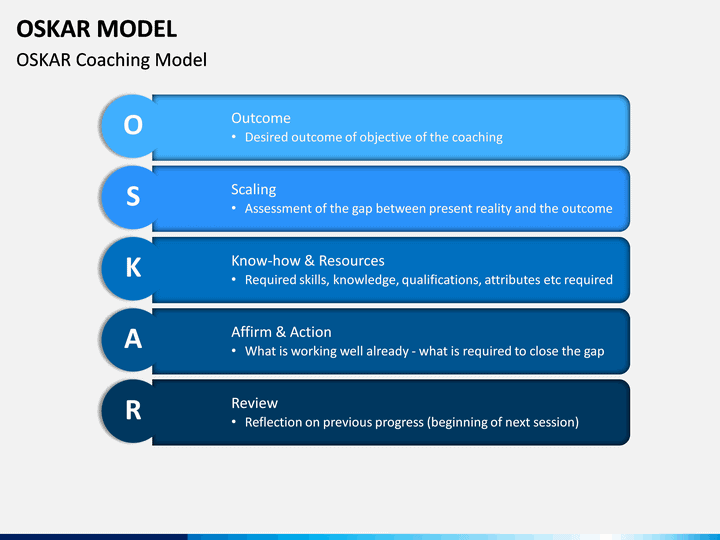
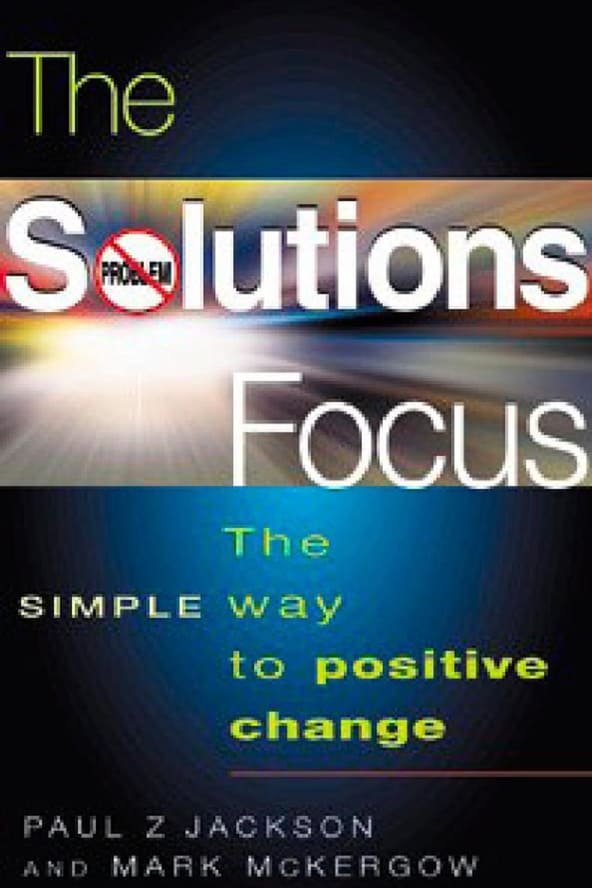
The OSKAR model is a coaching model from a popular branch of coaching, called Solution-Focused Coaching. It was developed by Mark McKergow and Paul Z Jackson. The related book ‘The Solution Focus’ (See Resources) is a fantastic read and very accessible to new coaches. We recommend it as an additional resource to this program.
The appeal of a solution-focused approach lies in a slightly extended definition of the coaching mindset: A solution-focused coach believes that in most cases the client already knows and ‘lives’ part of their desired solution. The coach helps the client (1) think of a future, where the solution is in place (2) scale their distance to it (3) unlock know-how (4) act towards it and (5) review the progress over time.
Similar to the GROW model, OSKAR is an acronym. We will discuss the steps below.
Outcome
In this step, coach and client agree on the desired outcome of the coaching. It is similar to the GROW model. A particularly famous (but easily overused) solution-focus question is the ‘Miracle Question’, which roughly works like this: “Imagine you wake up in 6 months and a miracle happened overnight and you achieved the goal that you had in mind. Imagine you have no idea that the miracle has happened and you simply start going into your day. What do you notice that tells you something is different?” The question can be an effective way to invoke by the coach and trigger awareness and perspective shift in the client, especially if they seem ‘stuck’ in the here and now. The question helps the client notice small changes and attributes to their desired solution, which is an often surprisingly effective reframing method.
Example: A client wants to nail the product presentation in front of a large stakeholder group in 2 months from now. They are concerned about appearing flippant and unfocused. Coach and client agree on the coaching goal of ‘delivering the session professionally’.
Scaling
In this step, coach and client get clarity how far the client is away from their desired outcome, often using a scale from 1 to 10. The coach will explore the resources that got the client to the point they mentioned and then help them imagine an appropriate step forward. Scaling allows for a great deal of creativity and can be done in many possible ways.
Example: The coach enquires with the client on their perceived degree of professionalism. They first define the ends of the scale: 1 meaning not professional at all and 10 meaning to fully achieve the agreed outcome. The client shares they are currently at a 4. The coach inquires first what brought them to a 4 and then helps the client think of ways to ‘inch’ or ‘leap’ forward.
Know-How
In this step, coach and client explore (1) existing know-how and resources that the client already has and (2) resources that the client needs to enable them to move forward to their desired outcome.
Example: The client realises that (1) being at a 4 means they already know a lot about the stakeholders and that technology is not an issue. The coach helps the client identify and concisely name those existing resources, as they signal where the solution is already partly in place. The client then (2) realises that to move forward they want to intentionally build allies to ensure buy-in before the actual presentation.
Affirm + Action
In this step, the coach helps the client commit to actions to move forward in a way that respects the client. Coach and client first agree what step on the scale sounds like an achievable goal. They then discuss next steps to make small or big progress on the scale to the desired outcome.
Example: The coach asks the client what milestones they can imagine to get from their current 4 to a 10 in 2 months when the presentation happens. Coach and client work through and document milestones and plan upcoming sessions to ensure that the client remains on track. Coach and client discuss potential obstacles to performance and pre-empt them through shared planning.
Review
This coaching phase typically happens at the beginning of subsequent coaching sessions, or (more liberally applied) in between. It indicates reflective practice to help the client notice what worked and what did not, to allow for adjustments and course corrections. ‘What’s better?’ is a typical and popular solution-focused question that kicks off the review with the client.
Summary
OSKAR is an empowering coaching model due to its future and solution-focus. Its positive assumptions on progress are motivating. Furthermore, the scaling that is part of the model allows for some intuitive ‘quantification’ of distance between the client’s current reality and where they want to go. Through this, it helps uncover and create awareness of resources and makes the path forward appear more manageable. Using the model, coach and client gain a way to fine-tune between big ‘leaps’ of progress or small steps, depending on the client’s preference.
The model’s strength is also its potential downside, as a repeated focus on Miracle Question and Scaling can easily be perceived as formulaic by clients. Focusing on small ’steps’ and progress can also distract from actual underlying challenges that the client wants or might need to overcome with a big step.
However, the real hidden ‘danger’ is that the agreement and scaling is made on a superficial element and not on what is truly important, i.e. there is a big difference between (1) ‘How prepared are you for the presentation, from 1 to 10?’ and (2) ‘What is your degree of confidence towards delivering the presentation concisely, from 1 to 10?’. Again, the focus and quality of the coaching agreement makes a big difference in the eventual success. We have observed that coaches who use this model for the first time often introduce scaling too early in the conversation and not on the right element.
Additional Resource: The Solutions Focus : https://www.amazon.com/The-Solutions-Focus-Making-Coaching/dp/1904838065
3. The DREAM Model
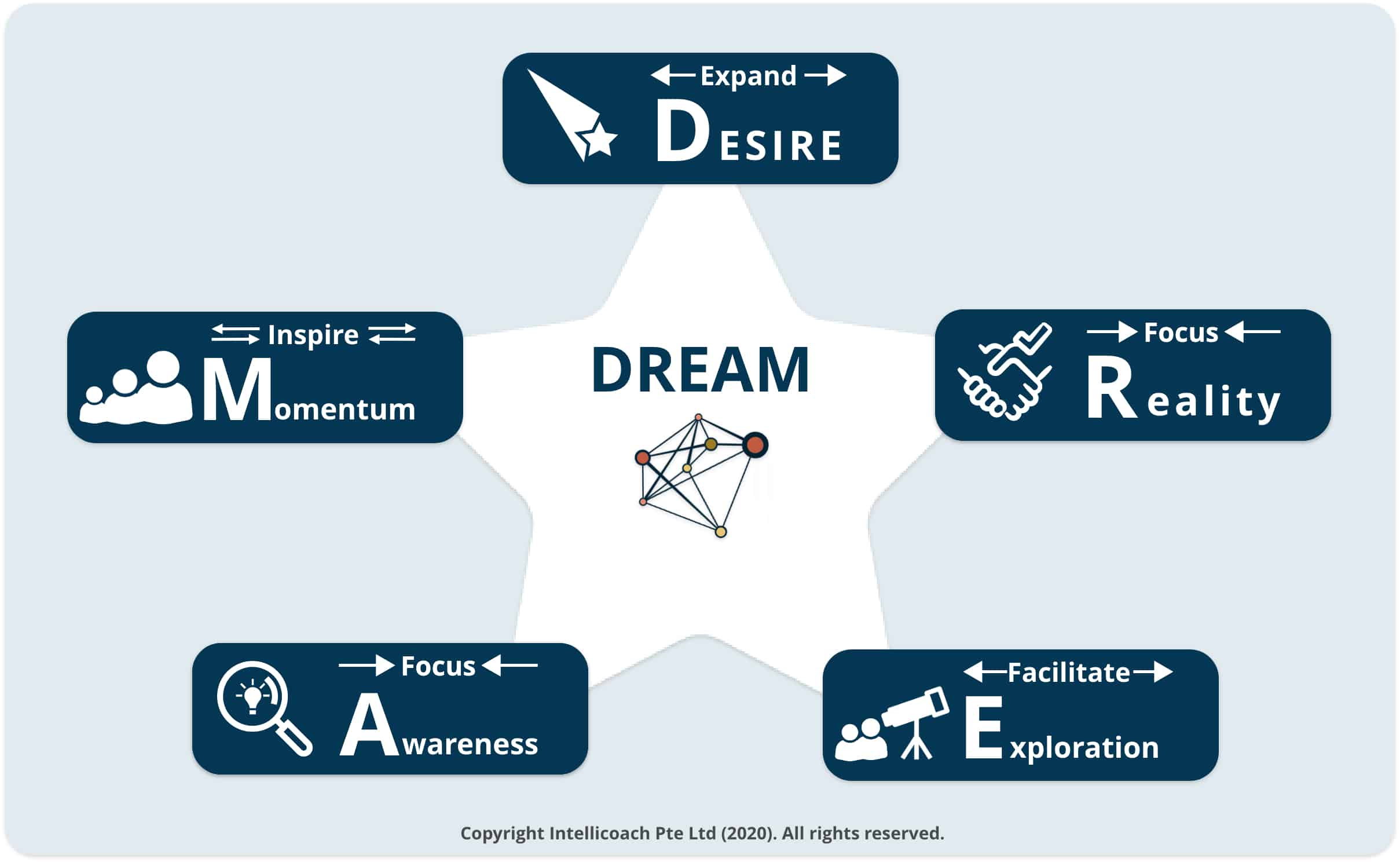
DREAM is a coaching model developed by IntelliCoach.
Its purpose is to capture and focus the coaching mindset and coaching core competencies for a transformative Coaching approach in a neat and easy-to-remember frame.
Note that as opposed to the GROW and OSKAR model, DREAM is not a model consisting of sequential steps. Instead, it is more useful to view the components as elements that combine into a useful coaching method. In transformative coaching, it is often the case that we can never anticipate when and how the client gains awareness; it may be at the very beginning, somewhere in the middle, or the very end.
Also, the model is designed to closely align to ICF Core Competencies and stresses the importance of the coaching agreement and focusing the client’s awareness. It also uses the basic idea of the ‘hour-glass’ model of coaching that indicates that coaching is typically a sequence of expanding and contracting parts.
The model consists of these 5 elements:
- Expand DESIRE: What does the client truly want? What is the underlying desire and dream? The difference here is that coach and client identify an emotional component that is connected to the goal.
- Focus REALITY: What can we realistically achieve in our coaching relationship? This element is about establishing the coaching agreement on a manageable ‘chunk’ and convert the dream/desire into something that both coach and client can partner and work on together.
- Facilitate EXPLORATION: Coach and client partner and explore creatively for new BEING and DOING. This may or may not be a dedicated element in the coaching conversation. Exploration also refers to the general method of inquiry used by the coach.
- Focus AWARENESS: What specifically does the client learn about themselves and the topic? In this element, coach and client work together to create meaning and clarity gained from exploring together.
- Inspire MOMENTUM: How can the client turn their learning and awareness into forward motion and maintain momentum? In this element, coach and client clarify their progress towards the coaching agreement, how it helped the client move towards their dream/desire and define concrete ways move on.
Expand DESIRE
This element in the DREAM model captures the desire of the client. This is different to a goal/destination/outcome, as covered in GROW or OSKAR, in that the coach aims to uncover what makes the topic important and relevant. It helps discover the relationship and connection of the coachee to their topic and challenge and likely includes an emotional component. Therefore, the purpose of this element in the DREAM model is to use coaching skills to accurately capture and confirm the real desire of the client, as it relates to the topic they bring forward.
The focus on ‘desire’ acknowledges that clients often bring a topic or goal that has to be ‘unpacked’ first and that we should not just ‘jump’ on the first things that the client mentions. The coach will intentionally spend time with the client to expand, clarify and capture what they really want. The true goal that clients have is likely a combination of a real-world outcome and an emotional impact. It may also be (true to the word DREAM) a long-term, ambitious goal that the client wants to approach.
Capturing the Desire will happen on the relationship level, as well as the session level, i.e. the DREAM model applies on both levels.
In terms of the hour-glass model of coaching, this is an element where the coach intentionally expands with the client to understand meaning and impact. It can happen in many parts of the coaching conversation.
For example, the coach may expand on the desire when the client has found an exciting way to move forward: ‘With this great idea in mind, what will be the benefit to you if you really made it work?’
To illustrate the DREAM model, we use an example scenario through all elements of the model.
Example: A client wants to make a big step forward in their career. They want to exit the corporate world by running their own online business. They say they want help from the coach to manage this enormous transition, and they feel they are not ready. Rather than just asking how ready they are and what they could do to increase their readiness (= transactional approach), the coach inquires about what makes the goal important and what the positive impact more readiness would be. It becomes clear that the client seeks autonomy and independence, and that these are the true benefits they are looking for, but also a bit scared about. An increase in independence is their true desire.
Focus REALITY
Once coach and client are both clear about the client’s desire in the topic they presented, coach and client form an agreement (on overall relationship or session level) on how exactly they should use their time together productively. The coach will use their competence and skill to form a strong coaching agreement to establish a clear session goal and measures of agreement.
By doing this, the coach clearly contrasts the desire/dream with a meaningful and more practical and realistic coaching goal that both partners can actually work on together. This element is important as it helps coach and client come to terms, set a meaningful goal and measure of success. This will also invite the client to think about what they specifically want to address or resolve in the session.
In terms of the hour-glass model of coaching, this is an element where the coach intentionally narrows/contracts the focus of the conversation. The coach’s intent is to achieve strong mutual clarity through effective headlining, summarising, clarifying and confirming. It is their role to help the client focus on the reality of the session right here and there and focus on what is in the client’s power or area of influence. The outcome should be a crisp and easy to remember agreement between coach and client that serves as a ‘red thread’ throughout the coaching conversation or relationship. Going forward, the coach will notice and share how near or far the client moves relating to this red thread. Having that focused reality also helps the client evaluate how they progressed.
Example Continued: The coach asks customised questions to help the client define an appropriate goal related to the topic/desire (becoming more independent when moving into their new career of an online business) for the 1h session they are in, i.e. ‘What could be good use our time today, related to your goal to become more independent in your career?’ The client shares that they are actually not clear how all this independence impacts work AND family and would like to get clarity and oversight on that. The coach confirms and asks how the client knew that the session was a success. The client responds they want to feel ready to share the idea with their spouse. The coach then inquires what the client thinks they should address first. The client shares they realise at that moment that they have not spent much thought about the impact to family and especially their spouse, and they are keen to start there.
Facilitate EXPLORATION
In this element of the model, coach and client partner to explore the client’s thinking, feeling and behaving in a way that helps them discover new angles and perspectives on their topic/goal/desire. The coach will continuously observe and assess the client’s progress and use invoking techniques as appropriate, i.e. powerful questions, headlining, sharing observations, using and sharing metaphors and analogies, etc.
However, exploration is different in one important aspect. It goes beyond being a specific, seperate element in the coaching process, but also refers to the general method of inquiry that the coach uses in all elements of the DREAM model. For example, the coach will explore with the client to form a strong coaching agreement. They will also explore potential obstacles to implementing actions that the client decided upon.
In the context of the hour-glass model, this element clearly relates to expanding meaning and options with the client.
Example Continued: The Coach inquires with powerful questions about the client’s realisation that they have not considered their family. The client notices that this is not the first time they had this feeling. The coach invites the client to zoom out for a moment and look at their behavior in the long run. The client notices a pattern and habit that they treat family as a second priority to work. The coach shares their observation that there seems to be a connection to the client’s values. The client agrees and shares that this is something they really want to change right now.

Focus AWARENESS
In this crucial element of the coaching model, the coach helps the client ‘condense’ gained learning and awareness. This may happen at any time during the conversation, i.e. during agreement, exploration or closure.
There are typically two ways to do this in a coaching conversation: (1) based on observation and (2) in the moment.
Firstly, there may be an observable moment of awareness and realisation by the client, where they changed perspective or had an idea. It is the coach’s role to notice when the client learned something new about their topic (the WHAT) or themselves (the WHO), to then slow the client down and invite their attention to that moment of realisation. ‘What happened just now when you sighed loud and leaned back?’. ‘I am curious…what did you just realise?’ are examples for how this could be done. It is helpful to moderate the client’s thinking by inviting to generate concise statements. The very act of turning an elaborate idea into something short and crisp is generative for the client. For example, we might ask: ‘I wonder, how might you phrase this realisation in just a handful of words?’ ‘How would you phrase this idea in a short newspaper headline?’
However, this first way has a few assumptions:
- it assumes that the coach picks up the realisation by the client
- it assumes that the realisation/awareness is something that the client will just come up with eventually and the coach just has to notice it
The second way to focus awareness happens in the moment and is to simply invite the client to reflect about the progress of the conversation, even if there was no apparent and obvious realisation or ‘aha’ moment.
It is simply good practice to check in with the client on how they see their progress. We can and should do this multiple times throughout the coaching conversation, to ensure they are on track. The questions may sound slightly different here, for example: ‘Now that we talked for about 20 minutes, what have you noticed so far about becoming more professional?’ ‘I wonder at this moment in our conversation, what has become clearer to you?’. These are important milestones in the coaching conversation to help our client realise their progress (or absence thereof), which in turn can be useful to adjust course.
Even more importantly, as mentioned before, summarising and reflecting on progress itself is a powerful invoking technique by the coach. It can be the very spark that ignites insight in the client. There are multiple coaching markers that relate to that very method.
Example Continued: The Coach shares that they noticed a strong reaction and conviction in the client when they talked about how their topic relates to their values. The coach invites the client to share in just a few words what they just realised about what they want. The client pauses and shares in honesty that family was an afterthought and that they want to build a new foundation, where work and family are ‘equal’ parts of an equation. The client notices that it is in their power to make that future happen.
Inspire MOMENTUM
This element of the coaching model refers to the coach’s skill to help the client move towards their own goal and future. This element typically (and most powerfully) follows right after the element of Focus Awareness. The coach makes a mental ‘switch’. They have noticed that the client had a realisation, a learning, an ‘aha’.
In this very moment, that insight is usually fragile and somewhat disconnected from the session goal. The coach’s role can be to invite the client to
- relate that insight to the relationship/session AGREEMENT and to the measure of success
- turn their insight into a new way of BEING, i.e. ‘how will you be different knowing this?’
- turn their insight into a new way of DOING, i.e. concrete behaviours, habits or next steps.
This element of the model will sound different when observed, as it is typically closer to an Accountability conversation. In it, the coach helps the client convert their learning, chart out the path forward and pre-empt potential obstacles.
Example Continued: The coach asks the client who they now want to BE going out of this conversation. The client thinks for a moment and then shares that they want to be someone who lives by their values. The Coach then asks how this relates to the sense of independence they wanted to create and how it relates to readiness in talking to their spouse (= measure of success). The client feels they made big progress in understanding themselves better, including their priorities, and they are keen to balance the equation (their metaphor) by talking to their spouse soon. The coach asks whether anything else might be needed to complete the conversation. The client mentions they are good to go and excited about the next step!
Summary
We designed the DREAM model to capture transformational coaching in a few important ways:
- it creates clarity on the alternating role of ‘expanding’ and ‘narrowing’ in a coaching conversation
- it highlights the importance the coaching agreement
- it stresses the ability of the coach to notice and ‘harvest’ moments in the conversation where the client gained awareness, as these are the most powerful sources to gain momentum
4. References and Links
The GROW Model Explained: https://youtu.be/K3iJwoydBbg
The Solution Focus – Book: https://www.amazon.com/The-Solutions-Focus-Making-Coaching/dp/1904838065
AFTER THE LIVE SESSION
The materials in this section are for your review after you have attended the online session. There is no need to look at this before the session.
Miro Board
Disabled
Session Recordings
Disabled