Setting Ourselves Up for Success
This lesson is Lesson 1-1 for a good reason. It is fundamental to your success in this program.
There are likely a myriad of success factors that contribute to a good training outcome, ranging from the participant, to the trainer, to content, to external factors and others. All of them play a role.
However, your mental readiness is special and decisive. You are the carrier of success. You are the resource to make it happen. You absorb. You implement. You succeed.
I will share the approach that IntelliCoach will take to help you assess and commit with intention before we embark on a development effort that involves personal growth.
The module ‘Become Prepared’ consists of three parts:
- Your Commitment
- Your Business Case
- Your Mindset
This lesson is about Commitment.
Courage, Humility and Discipline
Early in 2020, I became certified in the Marshall Goldsmith Stakeholder Centered Coaching method. Goldsmith is one of the highest ranking executive coaches in the world. Aside from becoming fluent in the method, I found it particularly interesting how clients/coachees are onboarded.
Goldsmith has noticed the 3 traits of Courage, Humility and Discipline (in the following mentioned as CHD) as being highly related to the eventual positive outcome of the engagement. In very simple words: Leaders who were low in CHD did not improve. They did not grow. On the other hand, 95% of the Leaders who displayed high degrees in these 3 dimensions were rated measurably higher in their Leadership effectiveness.
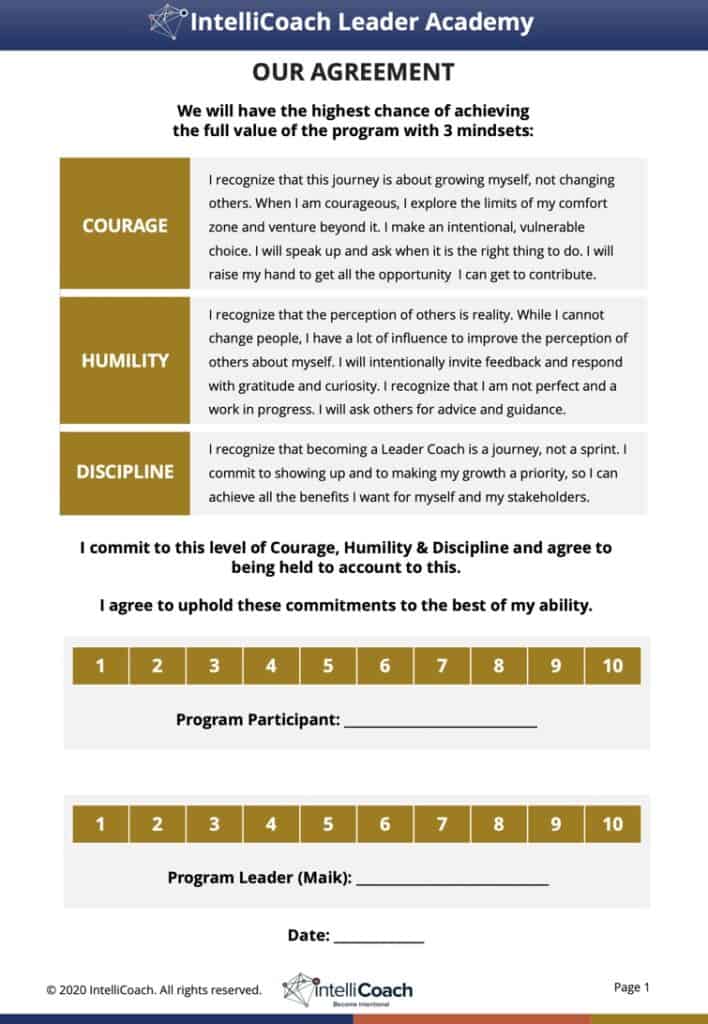
The practical implication? At the beginning, coach and client spend time together to understand how much CHD the client is willing to bring in, on a scale of 1 to 10. If any of the dimensions is below 8, a focused conversation would happen to understand more. It would either mean that the Leader/Client/Coachee would internally ‘renegotiate’ with themselves and commit to a higher level OR they would decide that it is not the right time to engage in the program.
I personally call this process early on in the client/coach relationship ‘mutual hiring’. It is not only the Leader hiring a competent and present Coach. The Coach is also hiring a Leader who is high in CHD, so that they are set up for success.
We want you to bring in high CHD into the IntelliCoach Leader Academy
Now, why am I telling you all this?
I deeply believe and know a few realities:
You are busy right now. Your life is full.
To participate in this course means you have to say NO to something. This requires Courage.
This course will challenge you and highlight blind spots.
You will be on the fast track to Personal Leadership growth. This means you will be in the spotlight a lot. Accepting feedback with grace and seeing others’ perceptions as reality takes a lot of Humility.
It is a journey, not a sprint.
Every overnight success has a long history of dedication behind it. You will face times when you think you want to prioritise away from the course. That feeling is normal. What matters is how we react to it. While the course and your peers will give a certain structure and external accountability, the main drive to see it through will be your internal Discipline.
If there is one big distinguishing criteria for members of the IntelliCoach Leader Academy, it is that they bring in high Courage, Humility and Discipline. This is the number 1 differentiator to eventual success that is fully in the control of the program member, i.e. YOU.
Let’s have a look at each of the three qualities in a bit more detail:
COURAGE means it is YOU who will grow.
Courage means to accept from the beginning that this journey about becoming a Leader Coach is about changing and growing YOURSELF.
It is easy in day-to-day interaction to point fingers at others and say that they are the focal point of needed change. We are not concerned about that. Our focus is to grow and learn to improve OURSELVES.
When we are courageous, we explore the limits of our comfort zone and venture beyond it to try new ways to communicate, even if we built seemingly working patterns over the past decades.
Courage in a program also means to speak up and to ask the questions that are likely on everyone’s mind. Courage also means that you share criticism and concerns about something the Facilitator does.
Lastly, courage also means to put your intentions into actual practice. Knowing is not automatically doing.
One typical example?
I saw many times over the years that Leaders find it relatively hard to actually express the coaching agreement in a conversation.
Why?
As coaches, we feel a contradiction here: On the one hand, we KNOW that the coaching agreement is absolutely essential. We MUST at some point in the conversation ask a variation of the question ‘What do you want to get out of this very conversation we are in right now?’. If not, the conversation has no goal. However, especially new coaches will feel that by asking this question they break a connection with the client. They become self-conscious; they feel pushy or formulaic, simply unnatural.
My take: to feel like this is actually very natural. It takes courage to try this question and extend your comfort zone around it. I have seen many Leaders make the leap and become intentional about their coaching agreement. You can do it, too!
HUMILITY means embracing perceptions as reality.
Humility means that all this is NOT about you.
Our performance is ultimately a reflection of the perception of other people. Our stakeholders, including our team, peers, customers, suppliers and leaders ultimately define our performance.
Humility means to accept with grace their perception as a given reality.
We can’t change people, but it is in our power to change the perception of the people around us with our actions and behaviours.
It also means not to lash back at the feedback from others, but instead to respond with ‘Thank you’ and curiosity to learn and to clarify what factors contributed to the perception they had.
Humility also means to admit that we are not perfect and that we are all works in progress.
Leadership is often assumed to work ‘differently’. I have seen countless times that even mature Leaders take it as their duty to project an image of certainty and infallibility.
What is one of the clearest signs of humility in a Leader in my personal view? They have no problem asking people for help and advice who have significantly less power than them AND they listen and act on what they hear. It has amazing effect when this happens.
DISCIPLINE is the magic sauce.
Discipline is about implementing and doing, in the face challenges.
There is one further reality in many longer courses that I would like to mention: Initial excitement is followed by the realisation of the need for effort. Exuberance is replaced with perseverance. I enjoyed a lot how the Marshall Goldsmith training prepared participating coaches to anticipate shifting priorities in clients and how we can help them stay on track when their discipline begins to falter.
As a Coach and your program facilitator, I see it as my role to help you make the connection between the amazing things you want to achieve for yourself with the training and the discipline that is required to get there.
In the simplest way, committing to a high degree of discipline firstly means to show up. It also means to anticipate a potential future drop in motivation and taking steps early to counter it.
Discipline is a magic sauce.
It leads to consistency, progress and (in more cases than not) achievement.
What is YOUR degree of CHD?
As mentioned in the beginning of this article, there is a lot of value in becoming intentional about how much Courage, Humility and Discipline we want to bring in.
The questions I would then ask you are quite simple:
1. On a scale of 1 to 10: what is the degree of courage you want to commit to in this course?
How willing are you to explore the corners of your comfort zone?
2. On a scale of 1 to 10: how willing are you to show humility?
How willing are you to actively and intentionally invite and act on the feedback and feedforward of the people around you, including your sternest critics?
3. On a scale of 1 to 10: what degree of discipline do you want to commit to?
How committed are you to turning the insights from the course into actual practice? How committed are you to becoming a proud, Certified Leader Coach?
Summary
In this article, I opened my workshop toolbox. How would I help a course participant set themselves up for success early on?
I shared what is in my view the most important and powerful way to help: developing and maintaining strong commitment.
This mindset has 3 qualities to it:
Courage: How willing are you to explore the corners of your comfort zone?
Humility: How willing are you to accept other’s perceptions of you as reality?
Discipline: How committed are you to do what it takes to become a great Leader Coach?
These three qualities are mentioned as CHD throughout the course. I have adapted this concept from the way I prepare my coaching clients as a certified Marshall Goldsmith’s stakeholder centered coach.
I explained that when participants are high on these three qualities, their chance to achieve measurable growth and success is very high. My deep belief is that when we help participants take stock early (before they commit) and assess their mindset, we do a great service to them.
They will go in stronger. They make an informed and intentional decision about the excited road that’s ahead of them.
Excited and high on CHD? Let’s get started!!

Your Next Steps
- Read the article to understand the concepts of CHD
- Download the Agreement Document via the button above.
- Annotate the PDF or print+sign+scan the document.
- Upload the file to your Personal IntelliCoach File Page. Or send it directly to your Mentor Coach via email.
We will talk about this agreement in the conversation that is part of Lesson 1-4. Your program mentor coach will contact you to meet a few weeks before the program starts!