Summary

Ethical and professional standards are the foundation of credibility and protection of the public for any profession, and that includes coaching!
Ethical practice means to establish clear expectations between the coach and coachee. It also establishes a clear standard to foster consistency in coaching quality.
Understanding and implementing these ethical and professional standards is essential in the practice of coaching. This lesson
- takes a close look at the Code of Ethics and especially confidentiality through a case study.
- looks at how we credibly explain the difference between coaching and other interventions, such as consulting or therapy.
Table of Contents

Lesson 2.2
1. Reference Competency and Markers
2. The Code of Ethics
3. Confidentiality
4. Coaching vs Consulting
5. When do I refer?
6. How to Prepare for the Live Session
Reference and Next Steps
1. Session Recordings + Miro Board
2. Post your REFLECTIONS
3. Mark this Lesson as COMPLETE + Do the Quiz
Lesson 2.2 Content
1. Reference Competency and Markers

We are including for reference the official descriptions of the ICF Core Competency and accompanying PCC markers. They will guide us through the lesson.
The Foundation – Demonstrates Ethical Practice
Competencies
Definition: Understands and consistently applies coaching ethics and standards of coaching
- Demonstrates personal integrity and honesty in interactions with clients, sponsors and relevant stakeholders
- Is sensitive to clients’ identity, environment, experiences, values and beliefs
- Uses language appropriate and respectful to clients, sponsors and relevant stakeholders
- Abides by the ICF Code of Ethics and upholds the Core Values
- Maintains confidentiality with client information per stakeholder agreements and pertinent laws
- Maintains the distinctions between coaching, consulting, psychotherapy and other support professions
- Refers clients to other support professionals, as appropriate
Source: ICF Core Competencies
Competency Markers
Familiarity with the ICF Code of Ethics and its application is required for all levels of coaching. Successful PCC candidates will demonstrate coaching that is aligned with the ICF Code of Ethics and will remain consistent in the role of coach.
Source: ICF PCC Markers
2. The Code of Ethics

Familiarity with the ICF Code of Ethics and its application is required for all levels of coaching.
Successful ICF-credentialled coaches will demonstrate coaching that is aligned with the ICF Code of Ethics and will remain consistent in the role of coach.
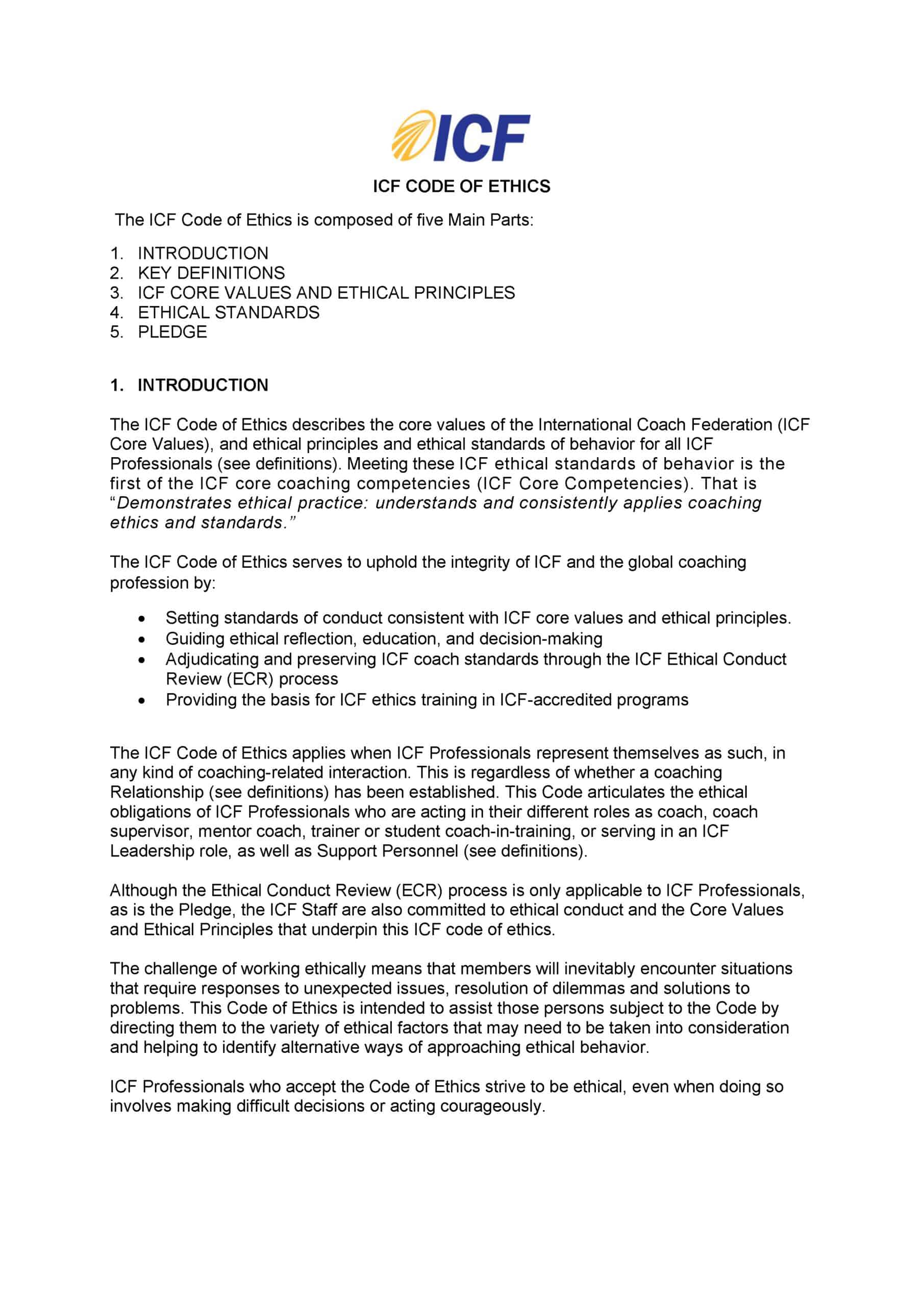
The Code has three essential parts:
- The first part defines terms such as “coaching,” “client,” and “conflict of interest.”
- The second part, ‘Standards of Ethical Conduct’, has five sections, addressing professional conduct at large, conflicts of interest, professional conduct with clients, confidentiality/privacy, and continuing development.
- The third part is a Pledge of Ethics.
Please ensure to read the Code of Ethics before the Live Session.
We also recommend to view the related Ethics FAQ by ICF: https://coachingfederation.org/ethics-faqs

3. Confidentiality

Confidentiality is a central theme in the Code of Ethics, which is why we take a deeper dive.
In this lesson, we will look at confidentiality from three angles:
1. The 2 levels of confidentiality
Confidentiality does not only refer to the content of the conversation, but also the existence of the coaching relationship itself!
2. The 3-way contract
If coaching happens in organisations, there is likely more than just the coach and coachee, but also other stakeholders with vested interest, such as the coachee’s Leader, the sponsor, HR, etc. This requires from us that we look at confidentiality in a different and expanded way.
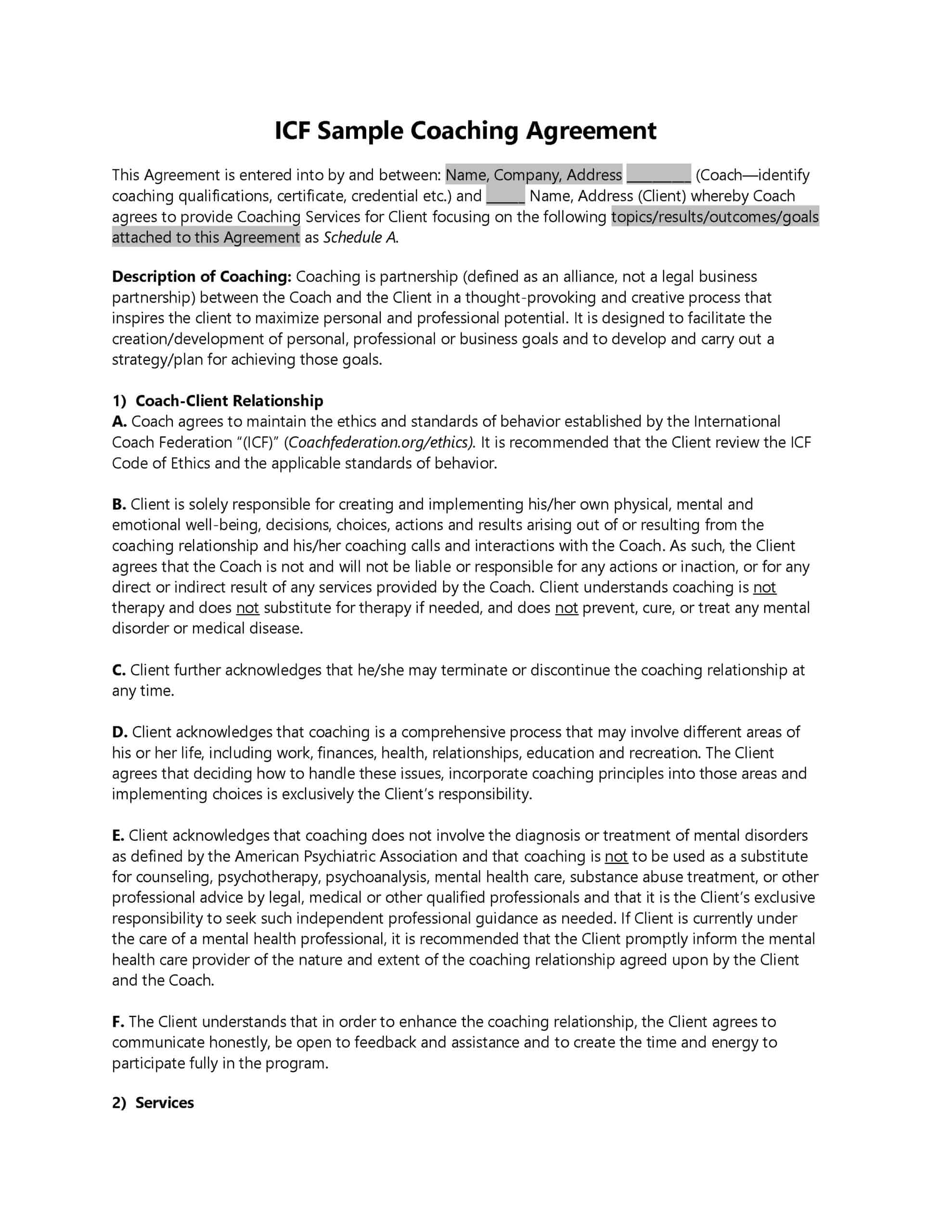
3. The Coaching Agreement
The agreement also has a central role in clarifying matters of confidentiality, especially regarding exceptions to it. The agreement has multiple levels and we will discuss it in detail in the respective lesson in lesson 2.4.
ICF publishes a sample coaching agreement to help coaches manage this important element and include it in their practice.
4. Case Study
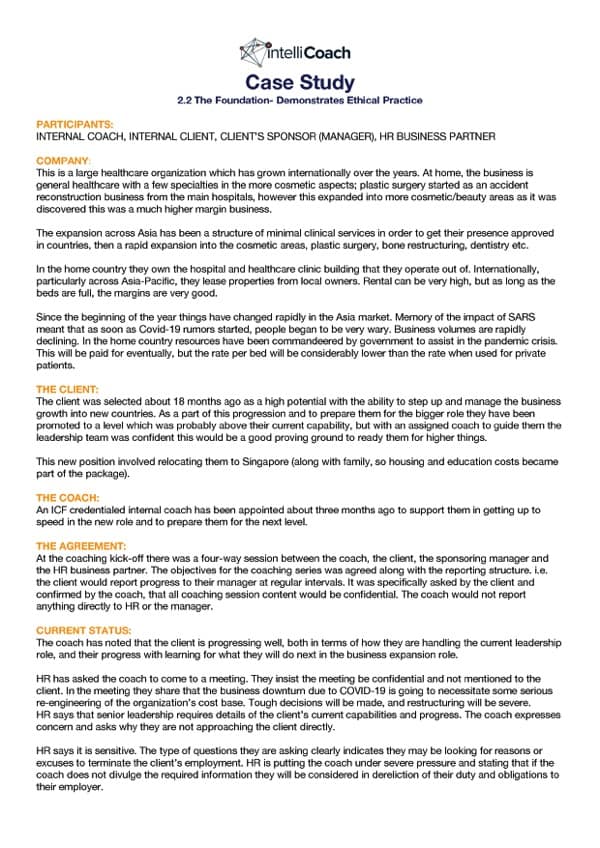
We will illustrate and discuss the particular challenges around confidentiality with a case study. It is a scenario that is more likely than you think!
Link: Case Study on Confidentiality
Please ensure to read the case study 1-pager before the Live Session.
4. Coaching vs Consulting

As a coach, we must demonstrate the “capacity to clearly communicate the differences between coaching, consulting, psychotherapy, and other helping professions, and the knowledge of when to refer a client to a different kind of professional practitioner.”
Let us have a closer look at the difference between Coaching and Consulting.
We will explore and practice in this lesson, how to clearly articulate this difference, as often our clients will see an ‘easy’ way out by asking for direct advice, challening the coach in their role as a thought partner partner.
What are the differences between both roles?
Coach
A coach partners with the client to create a better future for them. They explore challenges or obstacles with a client, through a series of thought-provoking conversations. They work collaboratively with the client to design action plans that will better enable the client to achieve her own goals. The coach asks questions that create insights to support the client to get from where they are to where they want to go. A coach may spend more time helping the client learn than a consultant would.
Consultant
A consultant is an expert who offers information and often gives expert advice, based on their experience, in an attempt to support a client. They are hired to provide solutions and expertise.
5. When do I refer?

One of the most important decisions that a coach makes is whether to accept the coaching assignment in the first place.
During the time when the overall coaching agreement is formed, the coach needs to assess the client’s readiness and whether coaching is in fact the right intervention.
It is possible for example that the client
- is not ready
- is not interested
- is unable to commit to the work required in the coaching process
- does not trust the coaching process
- perceives the coaching as imposed or coerced
- feels like they are not in a sufficiently safe and confidential environment
- is not interested in changing their own behavior
Some of the things we might observe as a coach could also prompt us to refer the person to a different practicioner, for example if the client
- is emotionally unstable
- has suicidal tendencies
- wants to resolve a medical or psycho-therapeutical matter
- experiences anxiety, depression, substance abuse and other pathologies.
How do we tell, when to accept or decline?
It is helpful in this moment to remember ICF’s definition of coaching as “partnering with clients in a thought–provoking, creative process that inspires them to maximize their personal and professional potential.”
If the client’s goals for coaching do not fall in this category, the client most likely should be referred to another more appropriate professional, such as a therapist or counselor.
6. How to Prepare for the Live Session

Familiarize yourself with the Code of Ethics. It is a foundational document that underpins everything an ICF-credentialled coach stands for.
Ask yourself while reading: How would I live the spirit of ethical coach practice?
We will discuss confidentiality by using a Case Study that illustrates a possible scenario in an organization.