Summary

This lesson is our last stop before we meet for the first time. It asks for two things:
- 1. Pre-think a number of Coaching topics that you want to bring into the program, i.e. something you want to do differently as a Leader + 1 relationship that you want to improve significantly.
- 2. Pre-read a number of impactful articles that prepare you well for the two content modules of the program. Please be prepared that we may refer to these articles and their content on occasion during the program.
Table of Contents

Lesson 1.5
1. Pre-Thinking your own Coaching Scenarios
2. ICF Coaching Core Competencies
3. Bersin Study – High-Impact Performance Management
4. HBR: Most Managers Don’t Know how to Coach People
5. HBR: The Leader As Coach
6. HBR: Your brain is hooked on being right
7. Radical Candor Podcast Episode 2
8. Essential Comms Podcast: Sorting and Labelling
9. The STAR and SBI Feedback models
10. Optional: ‘The Coaching Habit’ + ‘The Advice Trap’
11. Optional: Chad Hall’s Primers on Coaching
12. Final Words
Lesson 1.5 Content
1. Pre-Thinking your own Coaching Scenarios

- You Coach
- You Observe Coaching
- You get Trained to Coach
- You get Coached
All four pillars are essential, yet it is hard to understate the power of the last one: Getting Coached. As part of our training, you will receive a lot of coaching from peers. This is an amazing gift on its own.
As part of this lesson, we want to help you get prepared for this important part of the journey, so you can take the most benefit from being coached over the coming months!
Prepare a number of Coaching Topics for yourself.
We would like you to prepare a number of highly relevant topics that YOU want to receive coaching on.
So how would you generally recognise a good coaching topic for the program?
It is real. Don’t make something up. Bring in a real topic.
It is important. While it may be safe to ask for coaching around your attitude towards the weather, it will hardly move the needle. Choose something that is deeply important to you…something that will have a great positive impact if you resolved it.
It is in your control. You might be tempted to bring up the fact that your organisation creates lots of red tape or that your company’s work-from-home setup does not work for you. However, how much can you really do about that? Choose something that is as much as possible in the realm of your own control.
It is positively stated. Imagine two children who play up in a tree. There is a sudden strong wind and the kids are in danger of falling down. One parent shouts up: “Be careful, don’t fall down!” The other shouts “Be careful, hold on tight to a branch near you!” Real story. One is positively and one is negatively stated. Which kid likely fell down? Exactly.
While it’s quite natural in daily conversation to state things negatively, a coaching goal should generally be stated positively, so it is clear what we actually want.
Here are 2 ideas how you can prepare:
1 thing you want to do differently as a Leader
Think about a behavior that you want to establish for yourself in the long-term (aside from Coaching) in the way you interact with stakeholders. Ideally, your goal and choice is based on feedback by peers, your boss or your team.
New behaviors typically take some time to ‘stick’, which makes them a good candidate for our coaching goal.
Note: if you are taking this course as an aspiring Leader (i.e. you are not currently a People Manager), think of it in terms of Influencing without authority. How do you want to grow your impact with the people you work with by expanding your Personal Leadership?
1 relationship that you want to improve significantly
Think about a relationship that you really want to invest in. Ideally, for this course, it is a work relationship with an important stakeholder, but it can also be an off-work relationship, if its improvement has a significant positive impact on your overall effectiveness. Improving a relationship (especially a damaged one) typically takes time, which makes it a good candidate for our coaching goal.
Write down a paragraph or two about these two coaching goals. Be ready to introduce them to a peer in the program in one of the early lessons.
Note: As part of Lesson 1.6, we will all also commit to ethical practice and confidentiality. All coaching that happens in our program is subject to the ICF Code of Ethics.
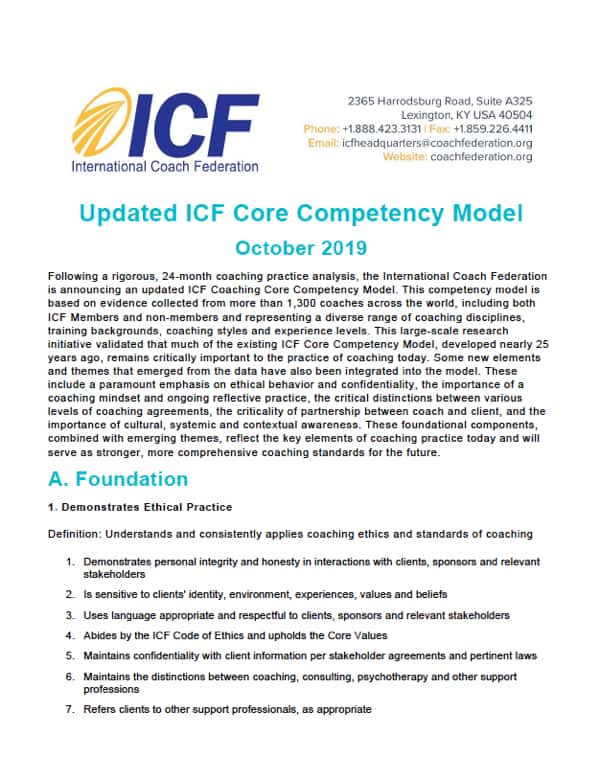
2. Pre-Read: ICF Coaching Core Competencies
1. The ICF Coaching Core Competencies
This document will accompany us all throughout the program and will remain an important reference point.
We will discuss this from Lesson 2.1 onwards.
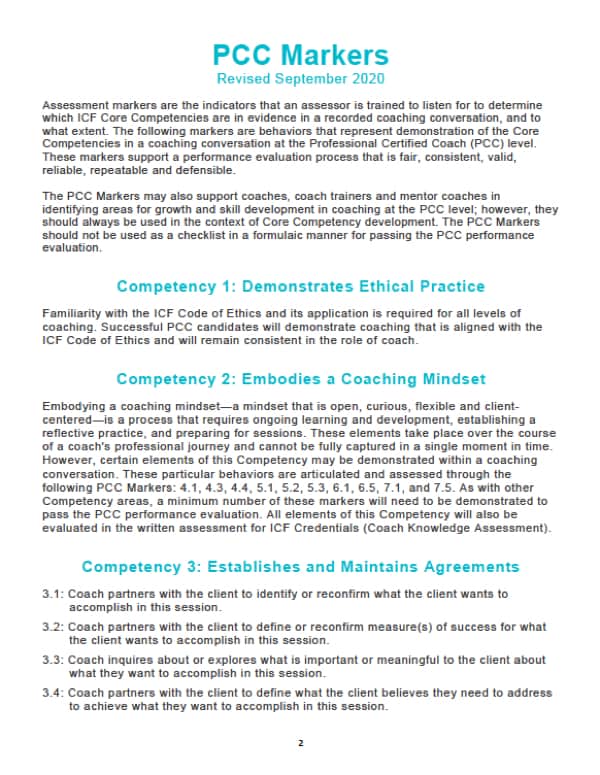
2. PCC Coaching Markers by ICF
This document outlines concrete behavioral markers for each competencies.
While ILAP does not certify to PCC level, we will use these markers as a guideline to assess coaching effectiveness. There are no markers defined for ACC level.
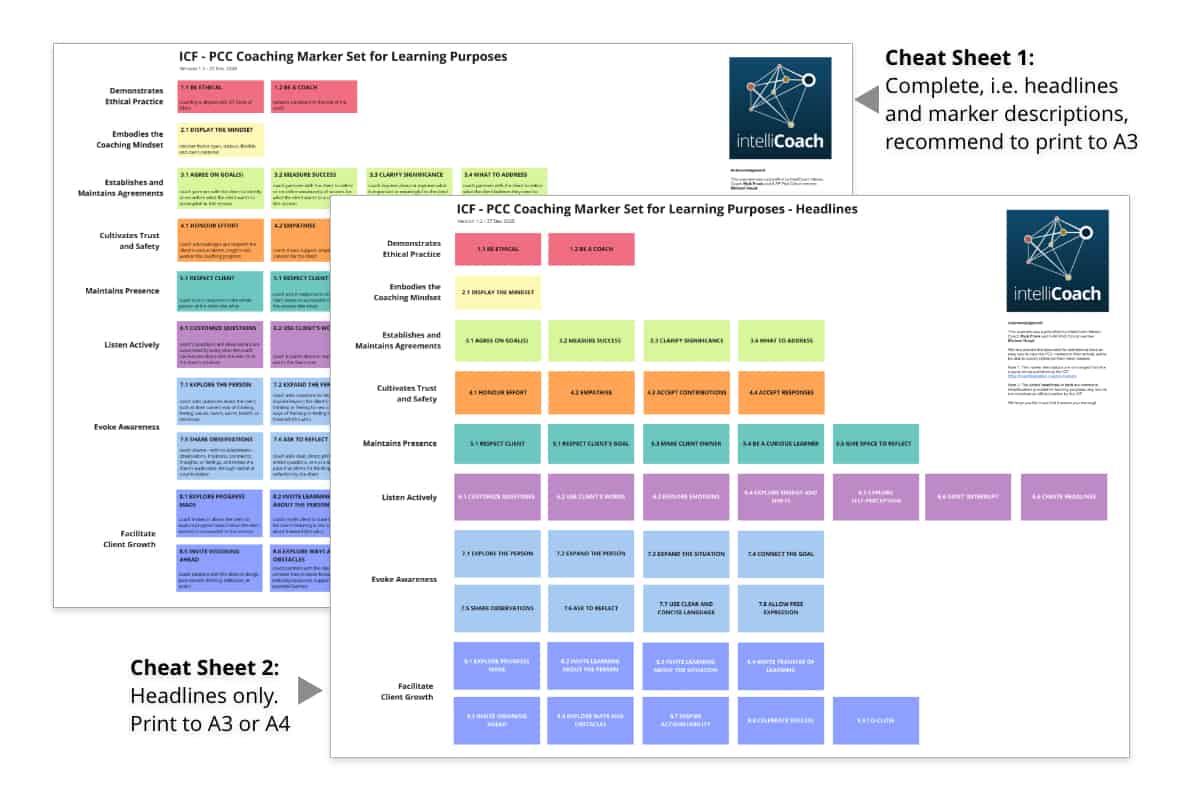
3. PCC Coaching Marker Cheat Sheets by IntelliCoach
The cheat sheets provided here were a joint effort by IntelliCoach Mentor Coach Maik Frank and ILAP Pilot Cohort member Michael Haupt.
We provide these documents for members to have an easy way to view the PCC markers in their entirety and to be able to quickly reference them when needed.
Note 1: The marker descriptions are unchanged from the original set as published by the ICF (see point 2 above)
Note 2: The added headlines in bold are intentional simplifications provided for learning purposes only and do not constitute an official position by the ICF.
We hope you like it and that it serves your learning!
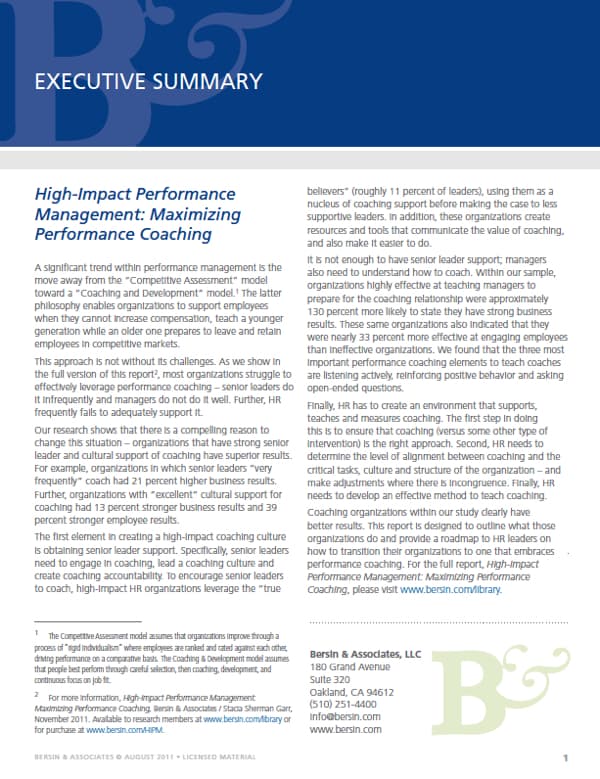
3. Bersin Study – High-Impact Performance Management
This study is a great reminder on the business case of teaching Leaders Coaching Skills.
4. HBR: Most Managers Don’t Know how to Coach People. But they can learn!
A well-founded and concise article to point out some of the common misconceptions around Coaching among Leaders.

5. HBR: The Leader As Coach
This article is a great resource that we will rely on a few times in Module 2 and 3.
6. HBR: Your brain is hooked on being right
A quite fun and insightful article pointing at a general human tendency. This is one of the reasons why coaching is a skill that must be learned.
7. Radical Candor Podcast Episode 2
Radical Candor is an amazingly simple and effective model to give effective feedback. We will use it and apply it right from the first lesson 1.6. I highly recommend this podcast. At minimum, you should listen to episode 2. If you have time, listen to the first handful of episodes. It will be well worth your time!

8. Essential Comms Podcast: Sorting and Labelling
‘The Look and Sound of Leadership’ is an amazing podcast and resource. One of the tools we will use right away is what they call ‘Sorting & Labelling’. It’s a technique that immediately helps us become more concise in our way of sharing ideas. We will introduce this right at the beginning of the course in lesson 1.6.
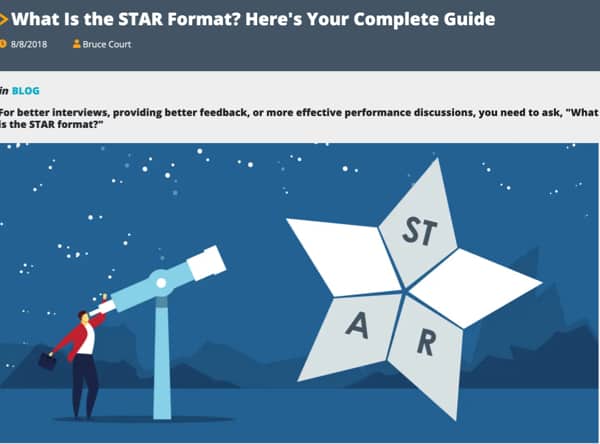
9. The STAR and SBI Feedback models
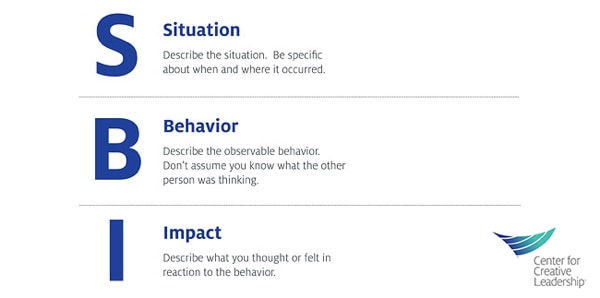
We will rely heavily on this model of Feedback, as it offers a technique complementary to Radical Candor. It’s highly practical and useful to learn a non-judgmental approach to giving Feedback.
2. The SBI Feedback model by the Center for Creative Leadership
This model is very similar to the STAR Feedback model above. In our course, we will look at both, as they offer different and important nuances.
https://www.ccl.org/articles/leading-effectively-articles/closing-the-gap-between-intent-and-impact/
10. Optional: ‘The Coaching Habit’ + ‘The Advice Trap’
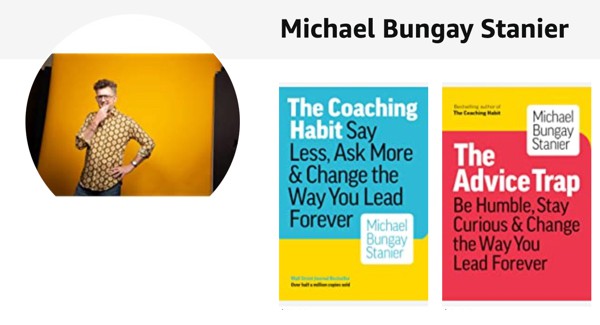
Michael Bungay Stanier has created two extremely accessible (and fun to read!) books on introducing Coaching. Highly recommended: ‘The Coaching Habit’ and ‘The Advice Trap’.
11. Optional: Chad Hall’s Primers on Coaching
Chad Hall’s Primers on Coaching are fantastic and quick summaries of powerful coaching approaches: ‘Coach the Person and not the Problem’, ‘The Coaching Mindset’ and ‘The Language of Life & Business Coaching’.

Final Words
- Take a few quiet minutes to really think about the coaching goals that you will bring into the course. The more intentional and real you are here, the more you will benefit.
- Read the articles and enjoy! They are selected for insight and impact and will greatly help you prepare for the course.